


About
Our lab explores the frontiers of particle physics and advanced computing at the CMS experiment of CERN’s LHC. We analyze rare processes involving the W, Z, and Higgs boson, namely the electroweak sectors, to test the Standard Model and search for new physics. In parallel, we develop GPU-accelerated software and scalable workflows that make high-throughput analysis fast and accessible.
We value open science, mentorship, and collaboration—students and postdocs lead projects that blend analysis, methods, and computing to push discovery forward.
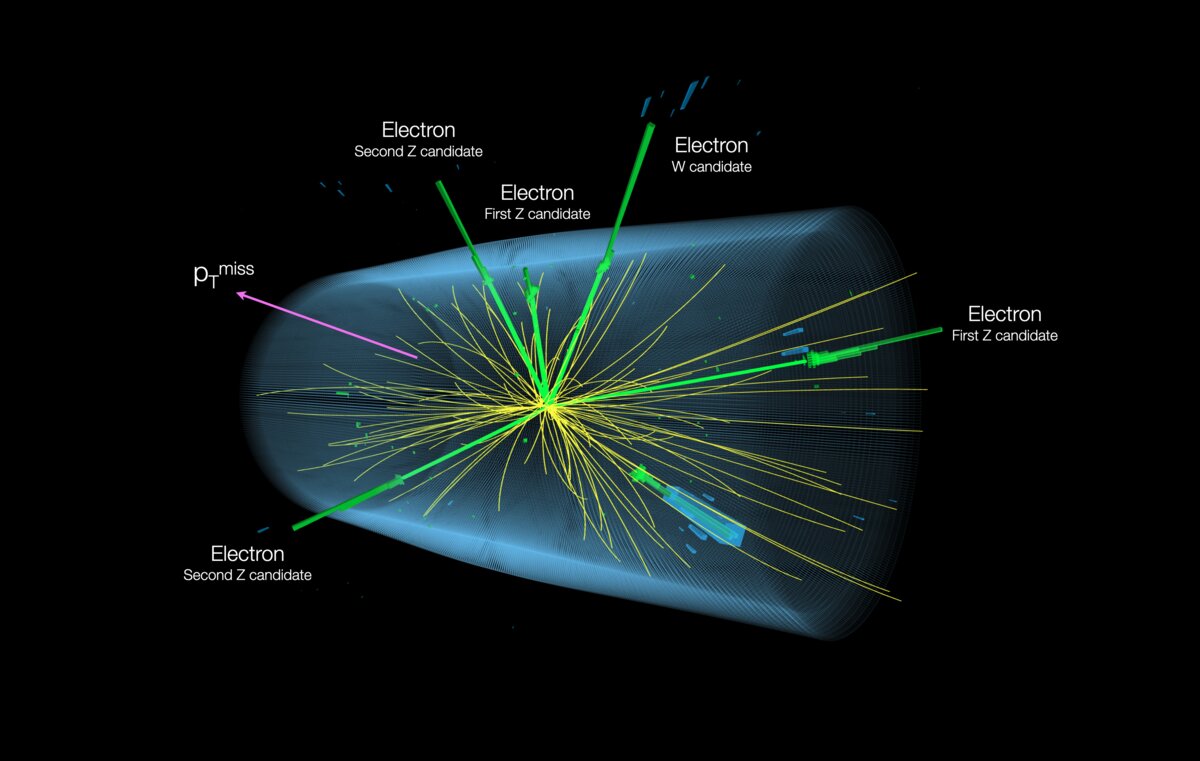
Our members are spread across Gainesville, Fermilab, and CERN, and we come together in one spot whenever we can—like at USCMS 2026 at the University of Maryland.


Lab News

June 4, 2026
Dr. Kelci Mohrman presented the Summary of the LPC EFT Workshop at JHU at USCMS 2026, wrapping up the workshop she co-organized

June 3, 2026
Alexandra Aponte Utani presented a poster on Line Segment Tracking (LST) at USCMS 2026

June 1, 2026
Prof. Philip Chang gave an invited talk at the LPC EFT Workshop at JHU on EFT in CMS: Recent Combinations and Future Visions / Questions

May 12, 2026
Dr. Matthew Dittrich successfully defended his PhD dissertation. Congratulations, Dr. Dittrich!

May 9, 2026
VVH Hackathon — the VVH group got together at Fermilab LPC for a hackathon

April 12, 2026
Prof. Philip Chang gave a TEDxUF talk on The Muon Collider: Our Muonshot for Understanding the Universe (YouTube)

March 31, 2026
Dr. Kelci Mohrman presented Topic of the Week at LPC on Exploring nature through the interactions of multiple heavy particles

March 18, 2026
Prof. Philip Chang presented at APS Global Summit 2026 in Denver, CO on Higgs Couplings and Quantum Numbers

February 3, 2026
Dr. Kelci Mohrman presented at the Aspen Winter Physics Conference 2026 on Electroweak Physics at the LHC

January 16, 2026
Alexandra Aponte Utani presented long-exercise on Bs→μμ at CMSDAS 2026 @ FNAL

January 14, 2026
Dr. Kelci Mohrman presented the long-exercise introduction at CMSDAS 2026 @ FNAL

January 5, 2026
Dr. Gustavs Kehris joins our group to work on AI problems for High-Energy Physics. Welcome!

December 9, 2025
Dr. Kelci Mohrman presented an update on VBS VVH analysis at CMS Week Seoul

December 8, 2025
Matthew Dittrich presented poster on WWZ measurement at CMS Week Seoul

November 12, 2025
Dr. Kelci Mohrman selected as the 2026 LPC Distinguished Researcher!

November 10, 2025
Dr. Eslam Zenhom successfully defends his Ph.D. thesis

October 9, 2025
Dr. Kelci Mohrman presented at MBI Workshop 2025 on WWZ and ZH production

October 9, 2025
Prof. Philip Chang presented at MBI Workshop 2025 on Triboson Physics

October 8, 2025
Amilqar Karam presented poster at CPAD 2025 at UPenn

May 21, 2025
Matthew Dittrich presented poster at USCMS 2025 on WWZ and ZH Cross Sections

May 20, 2025
Prof. Philip Chang presented at Pheno2025 on Recent LHC Results
October 24, 2024
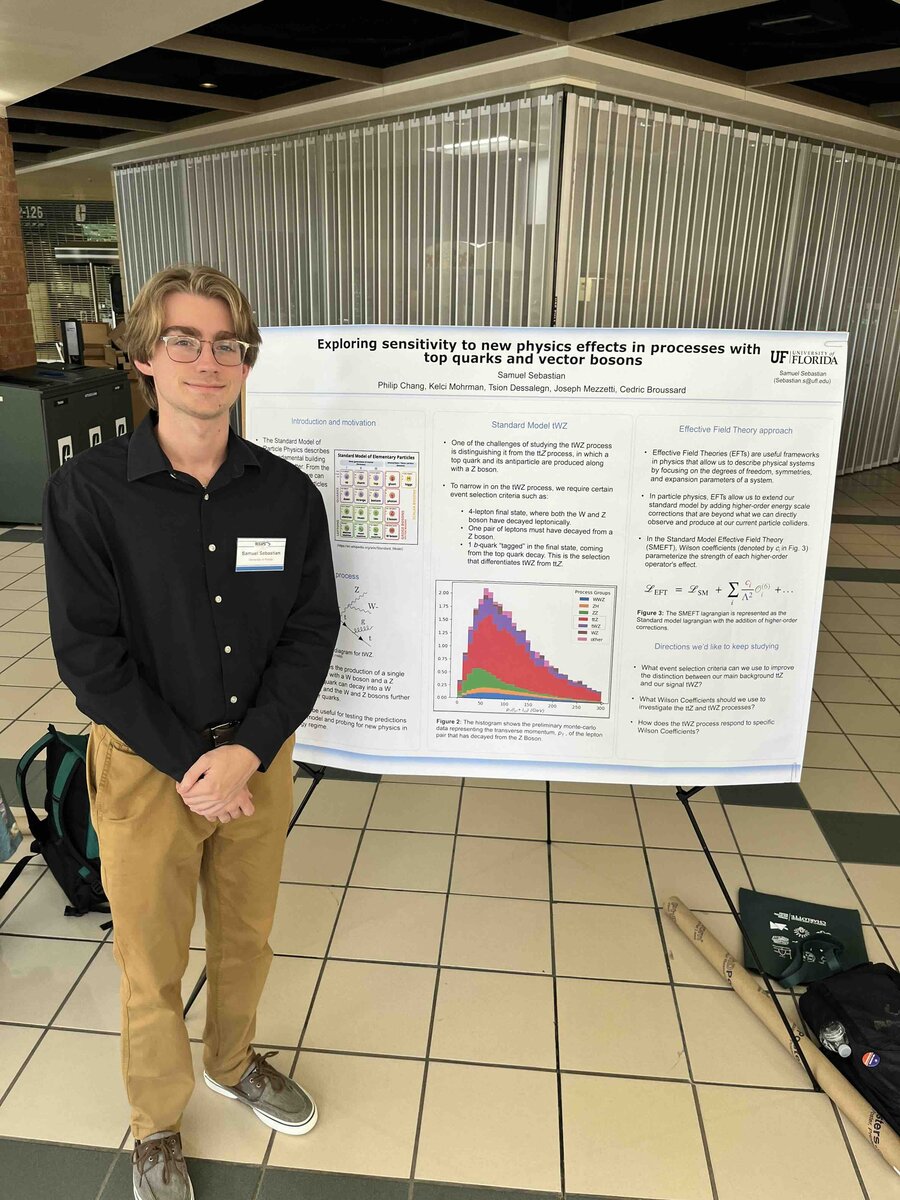
Samuel Sebastian presented poster at SESAPS 2024 at UNC Charlotte

February 20, 2024
Dr. Kelci Mohrman presented at Lake Louise Winter Institute 2024

September 26, 2023
Dr. Kelci Mohrman presented at TOP 2023 at Traverse City on EFT-related measurements ATLAS+CMS
Research

New Physics Search with Triboson using EFT
A comprehensive search for new physics in triboson production across a wide variety of final states using the Standard Model Effective Field Theory (SMEFT) framework. The analysis places some of the most stringent constraints on dimension-six SMEFT operators governing electroweak gauge boson self-interactions.
Read more
A comprehensive search for new physics in triboson production across a wide variety of final states using the Standard Model Effective Field Theory (SMEFT) framework. The analysis places some of the most stringent constraints on dimension-six SMEFT operators governing electroweak gauge boson self-interactions.

Muon Collider Studies
Muon colliders offer a unique path toward multi-TeV lepton collisions with clean experimental signatures and direct sensitivity to new physics. We explore simulation strategies, detector concepts, and physics potential — ranging from precision Higgs measurements to searches for Beyond the Standard Model phenomena.
Read more
Muon colliders offer a unique path toward multi-TeV lepton collisions with clean experimental signatures and direct sensitivity to new physics. We explore simulation strategies, detector concepts, and physics potential — ranging from precision Higgs measurements to searches for Beyond the Standard Model phenomena.

Higgs + Two Vector Boson Production via VBS
The quartic couplings between two Higgs bosons and vector bosons (HHWW and HHZZ) remain among the least constrained in the Higgs sector. This CMS study presents the first direct search for VBS VVH production, setting the most stringent limits yet on the VVHH (κ2V) coupling.
Read more
The quartic couplings between two Higgs bosons and vector bosons (HHWW and HHZZ) remain among the least constrained in the Higgs sector. This CMS study presents the first direct search for VBS VVH production, setting the most stringent limits yet on the VVHH (κ2V) coupling.

Measurement of WWZ and ZH Production
We led the first simultaneous measurement of nonresonant WWZ and ZH (H→WW) production at √s = 13 and 13.6 TeV — the most precise determination of the WWZ cross section to date and first evidence for triboson production at 13.6 TeV.
Read more
We led the first simultaneous measurement of nonresonant WWZ and ZH (H→WW) production at √s = 13 and 13.6 TeV — the most precise determination of the WWZ cross section to date and first evidence for triboson production at 13.6 TeV.

WH Production via Vector Boson Scattering
We study the production of a Higgs boson in association with a W boson through vector boson scattering, providing direct access to the WWH coupling and sensitivity to modifications of the Higgs sector.
Read more
We study the production of a Higgs boson in association with a W boson through vector boson scattering, providing direct access to the WWH coupling and sensitivity to modifications of the Higgs sector.

First Observation of Three Massive Gauge Boson Production
The first observation of VVV production, including evidence for WWW and evidence for WWZ, confirms a key prediction of the Standard Model and opens a new triboson physics program at the LHC.
Read more
The first observation of VVV production, including evidence for WWW and evidence for WWZ, confirms a key prediction of the Standard Model and opens a new triboson physics program at the LHC.

Line Segment Tracking (LST)
A highly parallelizable GPU-based track finding algorithm for the High-Luminosity LHC. LST reconstructs tracks from short, local segments, dramatically reducing combinatorial complexity for fast and scalable track finding.
Read more
A highly parallelizable GPU-based track finding algorithm for the High-Luminosity LHC. LST reconstructs tracks from short, local segments, dramatically reducing combinatorial complexity for fast and scalable track finding.

Search for Three W Gauge Boson Production
WWW production provides a sensitive window into quartic electroweak gauge couplings. The analysis also set the first experimental limits on photophobic axion-like particle models.
Read more
WWW production provides a sensitive window into quartic electroweak gauge couplings. The analysis also set the first experimental limits on photophobic axion-like particle models.

Higgs Boson Physics in the WW Decay Channel
Observations in the H→WW channel provided the first evidence for VBF Higgs production, strong constraints on Yukawa coupling strength, and explored links between the Higgs boson and dark matter.
Read more
Observations in the H→WW channel provided the first evidence for VBF Higgs production, strong constraints on Yukawa coupling strength, and explored links between the Higgs boson and dark matter.
In the Media


Muon Collider in the Spotlight
Media coverage on the physics potential and challenges of building a future muon collider.
Nature coverage →
New York Times coverage →
Science Magazine coverage →
US Muon Collider Collaboration →
Probing Interactions Among Trios of Heavy Vector Bosons
CMS article on the first observation of triboson production at the LHC, probing electroweak self-interactions at unprecedented energies.


Triple Threat: Massive Gauge Bosons at the LHC
Coverage of triboson production and what it reveals about electroweak self-interactions and rare multi-boson dynamics.
Phys.org →
APS Physics Magazine →
Symmetry Magazine →
CERN Press Release →
CMS Press Release →
CERN Courier →

Higgs Boson Physics
These articles highlight the first clear observation of the Higgs boson decaying to two W bosons, a milestone that tests the Higgs mechanism.
CERN Courier coverage →
ATLAS Physics Briefing →
UIUC Department News →
People


Alexandra Aponte Utani
4th Year PhD Student

Mayra Schrock
3rd Year PhD Student

Grace Caraballo-Gerén
BS Student
Diego Garcia
BS Student
Lucas Golden
BS Student

Justin Heyman
BS Student

Dorian Holt
BS Student

Mikael Nelson
BS Student

Mabroor Newaz
BS Student

Trevor Sabitsch
BS Student
Lucas Smith
BS Student
Alumni
- Hubert Pugzlys — Univ. of Florida (2026 BS Physics) — Applied Physics PhD, Caltech
- Dr. Matthew Dittrich — Univ. of Florida (2026 PhD Physics) — Senior GN&C Engineer, Lockheed Martin
- Cedric Broussard — Univ. of Florida (2025 BS Physics)
- Dr. Eslam Zenhom — Univ. of Florida (2025 PhD Physics)
- Amilqar Karam — Univ. of Florida (2025 BS Physics) — Physics PhD, Johns Hopkins University
- Samuel Sebastian — Univ. of Florida
- Joseph Mezzetti — Univ. of Florida
- Tsion (Zion) Dessalegn — Univ. of Michigan-Flint (PURSUE Intern 2024)
Public Talks & Seminars


Then and Now: Developments in the Large Hadron Collider
Particle Fever — Science on Screen, Dec 2022, Enzian Theater, Maitland FL
• Public Seminar: “New Frontiers of Electroweak Physics at the LHC” — Mid-Florida QuarkNet Day 2024
• Public Seminar: “An Invitation to Imagine Something from Nothing” — Galesville Astrophysical Society 2024
Seminar / Colloquium / Conference Talks
- “EFT in CMS: Recent Combinations and Future Visions / Questions” — Invited, LPC EFT Workshop, Johns Hopkins University, Baltimore, MD (Jun 2026)
- “Higgs Couplings and Quantum Numbers” — Invited Plenary, APS Global Summit 2026, Denver, CO (Mar 2026)
- “Triboson Physics” — Invited Plenary, MBI Workshop, Waltham, MA (Oct 2025)
- “Measurement of WWZ and ZH production cross sections at √s = 13 and 13.6 TeV” — Invited Parallel, KSEA US-Korea Conference, Atlanta, GA (Aug 2025)
- “Extreme Computing” — Invited Plenary, Physics At The Highest Energies (Galileo Galilei Institute), Florence, Italy (Jul 2025)
- “Higgs Physics: What is in the vacuum?”
- Invited Seminar, PURSUE Program, Fermilab (Jun 2025)
- Invited Seminar, PURSUE Program, Fermilab (Jul 2024)
- “Recent LHC Results” — Invited Plenary, Pheno 2025, Pittsburgh, PA (May 2025)
- “Computing R&D: How we get to our targets” — Invited, LHCP 2025, Taipei, Taiwan (May 2025)
- “Forging New Paths to Unveil the Electroweak Sector” — Colloquium, Univ. of Florida, Gainesville, FL (Mar 2025)
- “Enhancing Particle Physics Discovery Through Computational Innovation” — Parallel, KSEA Southeastern Regional Conference, Orlando, FL (Mar 2025)
- “Muon Collider the Dream Machine” — Parallel, KSEA US-Korea Conference, San Francisco, CA (Aug 2024)
- “GPU Programming” — Invited Lecture, HSF-India HEP Software Workshop, Delhi, India (May 2024)
- “AI for Particle Tracking” — Parallel, KSEA Southeastern Regional Conference, Gainesville, FL (Mar 2024)
- “LHC Future Opportunities” — Invited Plenary, Aspen Winter Conference, Aspen, CO (Mar 2024)
- “Line Segment Tracking at CMS” — Parallel, CHEP, Norfolk, VA (May 2023)
- “Recent CMS results on Standard Model Physics” — Parallel, CIPANP, Lake Buena Vista, FL (Sep 2022)
- “Recent CMS results on Higgs physics” — Parallel, CIPANP, Lake Buena Vista, FL (Aug 2022)
- “New frontiers of electroweak physics at the LHC”
- Invited Seminar, PKU / SJTU Collider Physics Forum, Virtual (May 2023)
- Invited Seminar, Univ. of Tennessee, Knoxville, TN (Sep 2022)
- Invited Colloquium, KAIST, Daejeon, Korea (May 2022)
- Invited Seminar, AKPA–KPS Joint Symposium, Virtual (May 2022)
- Invited Colloquium, Univ. of Alabama, Tuscaloosa, AL (Mar 2022)
- Invited Colloquium, Univ. of Notre Dame, Notre Dame, IN (Mar 2022)
- Invited Colloquium, Univ. of Florida, Gainesville, FL (Jan 2022)
- Invited Seminar, Univ. of Notre Dame HEP Seminar, Notre Dame, IN (Jan 2022)
- “Observation of production of three massive gauge bosons”
- Invited Seminar, Univ. of Florida HEP Seminar, Gainesville, FL (Jan 2022)
- Invited Seminar, Univ. of Illinois HEP Seminar, Urbana, IL (Mar 2021)
- Invited Seminar, Univ. of Pittsburgh HEP Seminar, Pittsburgh, PA (Dec 2020)
- Invited Seminar, UCSB HEP Seminar, Santa Barbara, CA (Oct 2020)
- Invited Seminar, Univ. of Michigan HEP Seminar, Ann Arbor, MI (Oct 2020)
- Invited Seminar, Univ. of Pennsylvania HEP Seminar, Philadelphia, PA (Sep 2020)
- Invited Seminar, Univ. of Maryland HEP Seminar, College Park, MD (Sep 2020)
- Invited Seminar, KSU/KU/UNL Joint HEP Seminar, Virtual (Sep 2020)
- Invited Seminar, Fermilab Wine & Cheese Seminar, Batavia, IL (Sep 2020)
- Invited Seminar, KIAS HEP Seminar, Seoul, Korea (Aug 2020) [YouTube]
- Invited Seminar, Univ. of Seoul HEP Seminar, Seoul, Korea (Aug 2020)
- Invited Seminar, Seoul National University HEP Seminar, Seoul, Korea (Aug 2020)
- Invited Seminar, Hanyang University HEP Seminar, Seoul, Korea (Jul 2020)
- Invited Seminar, Yonsei University HEP Seminar, Seoul, Korea (Jul 2020)
- Invited Seminar, Korea University HEP Seminar, Seoul, Korea (Jul 2020)
- Invited Seminar, Rice University HEP Seminar, Houston, TX (Jun 2020)
- Invited Seminar, Harvard/MIT LPPC Seminar, Boston, MA (Jun 2020)
- Invited Seminar, UC San Diego HEP Seminar, San Diego, CA (May 2020)
- “Multiboson physics at CMS” — Invited Symposium, Korean Physical Society Spring Meeting, Virtual (Apr 2021)
- “Search for heavy triboson production in leptonic final states” — Parallel, ICHEP 2020, Prague, Virtual (Jul 2020) [YouTube]
- “Parallelizable Track Pattern Recognition in HL-LHC” — Connecting the Dots Workshop, Princeton, NJ (Apr 2020)
- “Measurements of triple gauge boson production in ATLAS and CMS” — Invited Workshop, LPC Multibosons at the Energy Frontier, Batavia, IL (Jul 2019)
- “Rare EW multiboson at LHC” — Plenary, LHCP 2019, Puebla, Mexico (May 2019)
- “Electroweak physics with multibosons at CMS” — Parallel, Pheno 2019, Pittsburgh, PA (May 2019)
- “Search for the SM production of WWW events” — Invited Seminar, LHC Physics Center Physics Forum, Batavia, IL (Jan 2019)
- “Searches for new physics in the Higgs sector” — Invited Seminar, Univ. of Pennsylvania, Philadelphia, PA (Mar 2016)
- “First evidence for vector-boson fusion H→WW”
- Invited Seminar, Univ. of Cincinnati HEP Seminar, Cincinnati, OH (Feb 2016)
- Invited Seminar, Univ. of Pittsburgh HEP Seminar, Pittsburgh, PA (Apr 2015)
- APS April Meeting, Baltimore, MD (Apr 2015)
- “Advanced Analysis Technique: Squeezing out information” — Invited Workshop, 4th Chicagoland Pheno–ATLAS Workshop, Chicago, IL (Nov 2015)
- “ATLAS VBF Trigger Overview” — Invited Workshop, 3rd Chicagoland ATLAS–Pheno Meeting, Chicago, IL (Jan 2015)
- “Higgs Properties” — Plenary, Physics in Collisions 2014, Bloomington, IN (Sep 2014)
Selected Publications
- CMS Collaboration, “Measurement of WWZ and ZH Production Cross Sections at √s = 13 and 13.6 TeV,” Phys. Rev. Lett. 135, 091802 (2025). [doi:10.1103/6z3d-zjw4]
- CMS Collaboration, “Study of WH production through vector boson scattering and extraction of the relative sign of the W and Z couplings to the Higgs boson in proton–proton collisions at √s = 13 TeV,” Phys. Lett. B 860, 139202 (2025). [doi:10.1016/j.physletb.2024.139202]
- CMS Collaboration, “Line Segment Tracking: Improving the Phase-2 CMS High Level Trigger Tracking with a Novel, Hardware-Agnostic Pattern Recognition Algorithm,” arXiv:2407.18231 (2024). [arXiv:2407.18231]
- CMS Collaboration, “Observation of the Production of Three Massive Gauge Bosons at √s = 13 TeV,” Phys. Rev. Lett. 125, 151802 (2020). [doi:10.1103/PhysRevLett.125.151802]
- CMS Collaboration, “Search for the production of W±W±W∓ events at √s = 13 TeV,” Phys. Rev. D 100, 012004 (2019). [doi:10.1103/PhysRevD.100.012004]
- ATLAS and CMS Collaborations, “Measurements of the Higgs boson production and decay rates and constraints on its couplings from a combined ATLAS and CMS analysis of the LHC pp collision data at √s = 7 and 8 TeV,” J. High Energy Phys. 08, 045 (2016). [doi:10.1007/JHEP08(2016)045]
- ATLAS Collaboration, “Observation and measurement of Higgs boson decays to WW,” Phys. Rev. D 92, 012006 (2015). [doi:10.1103/PhysRevD.92.012006]
- ATLAS Collaboration, “Measurements of Higgs boson production and couplings in diboson final states with the ATLAS detector at the LHC,” Phys. Lett. B 726, 88–119 (2013). [doi:10.1016/j.physletb.2013.08.010] [Erratum: Phys. Lett. B 734, 406 (2014). doi:10.1016/j.physletb.2014.05.011]
- ATLAS Collaboration, “Observation of a new particle in the search for the Standard Model Higgs boson with the ATLAS detector at the LHC,” Phys. Lett. B 716, 1–29 (2012). [doi:10.1016/j.physletb.2012.08.020]
- G. Niendorf, T. Reid, P. Wittich, P. Elmer, B. Wang et al., “Line Segment Tracking in the HL-LHC,” arXiv:2207.08207 (2022). [arXiv:2207.08207]
- P. Chang, P. Elmer, Y. Gu, V. Krutelyov, G. Niendorf et al., “Segment Linking: A Highly Parallelizable Track Reconstruction Algorithm for HL-LHC,” J. Phys. Conf. Ser. 2375, 012005 (2022). [doi:10.1088/1742-6596/2375/1/012005]
- CMS Collaboration, “First observation of production of three massive gauge bosons,” PoS ICHEP2020, 325 (2021). [doi:10.22323/1.390.0325]
- ATLAS and CMS Collaborations, “Studies of rare electroweak multiboson interactions at the LHC,” PoS LHCP2019, 107 (2019). [doi:10.22323/1.350.0107]
- V. Cavaliere, J. Adelman, P. Albicocco, J. Alison, L.S. Ancu et al., “Design of a hardware track finder (Fast Tracker) for the ATLAS trigger,” JINST 11, C02056 (2016). [doi:10.1088/1748-0221/11/02/C02056]
- G. Volpi, J. Adelman, P. Albicocco, J. Alison, L.S. Ancu et al., “The ATLAS fast tracker processor design,” PoS VERTEX2015, 040 (2015). [doi:10.22323/1.254.0040]
- J. Anderson, A. Andreani, A. Andreazza, A. Annovi, M. Atkinson et al., “A fast hardware tracker for the ATLAS trigger system,” Nucl. Instrum. Meth. A 718, 258 (2013). [doi:10.1016/j.nima.2012.11.133]
- J. Anderson, A. Andreani, A. Andreazza, A. Annovi, M. Atkinson et al., “FTK: A Fast Track Trigger for ATLAS,” JINST 7, C10002 (2012). [doi:10.1088/1748-0221/7/10/C10002]
Teaching
- Spring 2026 — PHY4905: Collider Physics at the Higgs Frontier
- Fall 2025 — PHY2060: Enriched Physics 1 w/ Calc (GatorEval: 4.68 / 5.00)
- Spring 2025 — PHY2048: Physics 1 w/ Calc (GatorEval: 4.30 / 5.00)
- Fall 2024 — PHY2048: Physics 1 w/ Calc (GatorEval: 4.26 / 5.00)
- Spring 2024 — PHY2048: Physics 1 w/ Calc (GatorEval: 3.53 / 5.00)
- Fall 2023 — PHY2048: Physics 1 w/ Calc (GatorEval: 3.31 / 5.00)
- Fall 2022 — PHY2049: Physics 2 w/ Calc, Discussion Sections (GatorEval: 4.38 / 5.00)
Blog
Musings on physics, computing, and everything in between.
October 13, 2026
What Keeps Me Up at Night About AI
AI will reshape academia, but what worries me more is how we train the next generation of well-rounded researchers.
March 5, 2026
The Garden, the Buckets, and the Channels
A small allegory about the arc of a PhD — from carrying buckets, to building channels, to choosing where your effort matters most.
February 25, 2026
AI analysis on AI impact on hep-th publications.
Using Claude Code to investigate whether arXiv hep-th submissions really doubled in late 2025.
Contact
p.chang@ufl.edu
Office
New Physics Building 2035
Address
Department of Physics
University of Florida
2001 Museum Road
Gainesville, FL 32603