
Research
In Laroche Lab, we specialize in designing and fabricating nano-structures to study the fascinating effects that arise when different materials and/or devices are interacting at the nanoscale. Utilizing state-of-the-art material systems with low disorder such as GaAs/AlGaAs heterostructures, InAs nanowires with an aluminium epilayer and InSb nanowires, we engineer coupled systems where novel phenomena occur, and attempt to harness their properties for future nano-electronics and quantum computing applications. The devices under study are characterized through electrical transport in a dilution refrigerator at ultra-low temperatures, in the range of a few tens of milikelvin, and in the presence of a magnetic field.
Coulomb drag between coupled 1D systems
Despite their conceptual simplicity, one-dimensional systems remain a challenge to understand owing to the enhanced correlations and interactions that occur due to their restricted phase-space. As such, the simple Fermi-liquid model describing the physics of solid-state electrons in 2D and 3D no longer holds in 1D, where electronic transport is instead described by the Luttinger-liquid model which accounts for these enhanced interactions. Experimentally studying the intrinsic properties of 1D systems is also a challenging task. Standard measurements generally probe processes occurring in the high dimensional system leads, thereby providing no information about the nature of electron-electron interactions inside the 1D system itself. In contrast, experiments in coupled 1D systems, such as Coulomb drag, effectively probe electron-electron interactions. By using dual side processing on GaAs/AlGaAs bilayer systems, two independently contacted quantum wires can be fabricated such that they are less than 15 nm apart.
 First fabrication step
- First fabrication step


We will use this platform, to perform Coulomb drag measurements, where a current in a quantum wire induces a voltage drop in the adjacent wire solely through Coulomb interactions. By measuring the dependence of the drag signal as a function of temperature, 1D density, magnetic field, geometry and material parameters, we will extract crucial information about the nature of Luttinger-liquids and about the strength of electron-electron interactions in a 1D systems.


Current research efforts :
Recently, we have measured an unexpected non-reciprocal Coulomb drag signal, both in laterally-coupled and vertically-coupled quantum wires. This signal was identified by measuring Coulomb drag using two opposite current directions. Combining both measurements together, the reciprocal signal is identified with the anti-symmetric component while the non-reciprocal signal is identified with the symmetric component. Further studies showed that the relative strength of both contributions is tunable with both temperature and wire width. Currently, we are studying the evolution of both signal as a function of interwire separation, magnetic field and disorder. We are also trying to explain why both contributions vary differently as a function of temperature.
Relevant publications :
- Quasi-one-dimensional Coulomb drag between spin-polarized quantum wires,
M. Zheng, R. Makaju, R.Gazizulin, A. Levchenko, S. J. Addamane, D. Laroche, Phys. Rev. B [accepted] - Tunable reciprocal and nonreciprocal contributions to 1D Coulomb Drag.
M. Zheng, R. Makaju, R.Gazizulin, S. J. Addamane, D. Laroche, Nature Communications volume 16, 6963 (2025). - Quasi-1D Coulomb Drag in the Nonlinear Regime
M. Zheng, R. Makaju, R.Gazizulin, A. Levchenko, S. J. Addamane, D. Laroche, Phys. Rev. Lett 134, 236301 (2025). - Nonreciprocal Coulomb drag between quantum wires in the quasi-one-dimensional regime.
R. Makaju, H. Kassar, S. M. Daloglu, A. Huynh, D. Laroche, A. Levchenko, and S. J. Addamane , Phys. Rev. B 109, 085101 (2024). - 1D-1D Coulomb Drag Signature of a Luttinger Liquid.
D. Laroche, G. Gervais, M. P. Lilly and J. L. Reno, Science, 343, 631 (2014). - Positive and Negative Coulomb Drag in Vertically Integrated One-Dimensional Quantum Wires.
D. Laroche, G. Gervais, M. P. Lilly and J. L. Reno, Nature Nanotechnolgy, 6, 793 (2011).
Majorana zero modes in hybrid superconductor-semiconductor devices
Topological quantum computations offer a promising approach to fault-tolerant quantum computing by encoding and manipulating the quantum information non-locally in a non-Abelian degenerate ground state that is intrinsically immune against disorder. Majorana-Zero-Modes (MZMs) in nanowires with induced superconductivity and strong spin-orbit coupling under a magnetic field are arguably the front-runner in establishing topological quantum bits, with numerous signatures of MZMs having been experimentally observed. In Laroche lab, we will use novel techniques to further measure the properties of these promising systems.
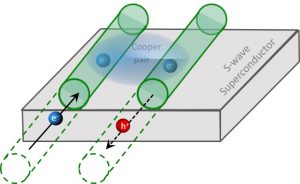
In addition, we will work towards developing a novel platform for the observation of MZMs, or their fractional counter-part the parafermions, in the absence of an applied magnetic field. The material of choice for this platform is hybrid superconductor-semiconductor nanowire pairs coupled to a common superconductor. By designing nanowire networks with sufficiently large electron-electron interactions, induced proximity can arise through crossed-Andreev reflections, which will naturally give rise to MZMs or parafermions, even without an applied magnetic field.
Current research efforts :
Our current efforts have shifted towards the fabrication of laterally coupled quantum wires in InAs heterostructures to measure Coulomb drag in this novel material platform and determine the impact of spin-orbit coupling on the drag measurements. Measuring Coulomb drag once a parent superconductor has been deposited on the wires to determine the strength of electron-electron interactions is the following step.
Relevant publications:
Observation of the 4π-periodic Josephson effect in InAs nanowires.
D. Laroche, D. Bouman, D. J. van Woerkom, A. Proutski, C. Murthy, D. I. Pikulin, C. Nayak, R. J. J. van Gulik, J., Nygård, P. Krogstrup, L. P. Kouwenhoven, A. Geresdi. Nature Communications 10, 245 (2019).
Exotic phenomena in coupled SiGe-based bilayers
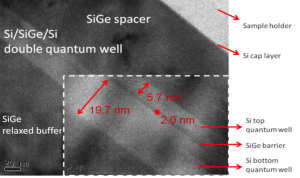
Si/SiGe and Ge/SiGe heterostructures have been showing great promises in the recent year. Their nearly defect free growth, significant spin-orbit interaction and the possibility to induce superconductivity make these structures a promising platform both for fundamental research and quantum computing applications. Utilizing the expertise developed in GaAs/AlGaAs bilayer systems, we will engineer devices where the density and the electronic confinement of Ge/SiGe bilayers can be controlled simultaneously from both side. This will open up exciting research opportunities in the field of vertically coupled wires and bilayer exciton condensation. Recent experiments showed a quantum state at ν_total = 1 that is consistent with the onset of exciton condensation.

Current research efforts :
We recently successfully achieve a device compatible with independent contact to each layer. Current efforts involve characterizing valley splitting in Si/SiGe bilayers, and in measuring signature of exciton condensation with the novel devices in Ge/SiGe bilayers.
Relevant publications :
- Density dependence of the excitation gaps in an undoped Si/SiGe double-quantum-well heterostructure.
D. Chen, S. Cai, N.-W. Hsu, S.-H. Huang, Y. Chuang, E. Nielsen, J.-Y. Li, C. W. Liu, T. M. Lu and D. Laroche Appl. Phys. Lett. 119, 223103 (2021). - Magneto-transport of an electron bilayer system in an undoped Si/SiGe double-quantum-well heterostructure.
D. Laroche, S.-H. Huang, E. Nielsen, C. W. Liu, J.-Y. Li and T. M. Lu, Applied Physics Letters, 106, 143503 (2015).