
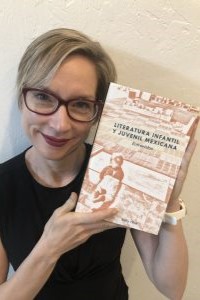
Books:
Literatura infantil y juvenil mexicana, 2020.
Dude Lit: Mexican Men Writing and Performing Competence, 1955-2012. Forthcoming with the University of Arizona Press.
Translated by Carl Good: Macholiteratura: Hombres mexicanos escribiendo y actuando la competencia, 1955-2012. Bonilla Artigas, 2025.
La generación XXX: Entrevistas con veinte escritores mexicanos nacidos en los 70. De Abenshushan a Xoconostle. México: Eón, 2013.
Femmenism and the Mexican Woman Intellectual from Sor Juana to Poniatowska: Boob Lit. New York: Palgrave Macmillan, 2010.
Entrevistas con quince autoras mexicanas. Madrid: Iberoamericana/ Frankfurt am Main: Vervuert, 2003.
Journal Articles:
Interview with Amaury Colmenares. “Entrevista a Amaury Colmenares.” A Contracorriente: Uma revista de estudios latino-americanos, Vol. 23, No. 2 (2026), pp. 215-231.
“El veget-alfabetismo en Supernaturalia de Norma Muñoz Ledo, Restauración de Ave Barrera y Desierto sonoro de Valeria Luiselli.” Balajú: Revista de Cultura y Comunicación de la Universidad Veracruzana. No. 22 (2025), pp. 66-96.
with Jorge Quintana Navarrete. Introducción. “Los estudios críticos de las plantas: Aproximaciones desde las culturas de México y Centroamérica.” Balajú: Revista de Cultura y Comunicación de la Universidad Veracruzana. No. 22 (2025), pp. 4-16.
Interview with Jazmina Barrera. Hispamérica, Vol. 51, No. 153 (2022), pp. 77-83.
Interview with Brigitte Broch. “Las plantas en el cine mexicano: ¿desastre ecológico o remedio visual? Conversación con la diseñadora de arte Brigitte Broch sobre Solo con tu pareja (1991), Sexo, pudor y lágrimas (1999) y Amores perros (2000).” Balajú: Revista de Cultura y Comunicación de la Universidad Veracruzana. No. 17 (2022), pp. 99-110.
Interview with Ave Barrera. “Ave Barrera al precipicio de la introducción al mundo anglófono.” A Contracorriente. Vol. 19, No. 3 (2022), pp. 327-344.
“Literary Fiction Under Coloniality and the Relief of Meditation in Guadalupe Nettel’s Desupés del invierno, Carla Faesler’s Formol and Laía Jufresa’s ‘La pierna era nuestro altar.’” Special Issue edited by Roberto Sirvent and Amy Reed-Sandoval, Disability and the Global South, Vol. 6, No. 1 (2019), pp. 1677-1694.
“Contemplation as Resistance to Ageism, and Its Historical Context: Mexican Writers Carmen Boullosa, Guadalupe Nettel, and María Rivera.” Special number of Life Writing, Vol 16, No. 1 (2019), edited by Margaret O’Neill and Michaela Schrage-Früh.**
**Republished as a book: Women and Ageing: Private Meaning, Social Lives. Routledge, 2021.
“Introversión, grasa, bullying y lo cool en la literatura mexicana para niños (y jóvenes): Aguilera, Brozon, Chacek, Dehesa, Hinojosa, Montiel Figueiras y Villoro.” Revista de Literatura Contemporánea Mexicana 67.22 (2016): 9-24.
Interview with Guillermo Fadanelli. “Entrevista a Guillermo Fadanelli.” A Contracorriente 14.1 (2016): 306-330.
Interview with Luis Felipe Lomelí. “El bárbaro doctorado del Norte: Entrevista con Luis Felipe Lomelí.” Confluencia 32.1 (2016): 208-223.
“Ageism, the Environment, and the Specter: The Broad Predicament in Carlos Fuentes’s Aura and Carmen Boullosa’s Antes.” Chasqui 44.2 (2015): 164-174.
“Starring Pirates: Metaphors for Understanding Recent Popular Mexican Film.” The Journal of Popular Film and Television. 41.4 (2013): 196-207.
“Estado de excepción y feminicidio: El Traspatio/ Backyard (2009) de Carlos Carrera y Sabina Berman,” The Colorado Review of Hispanic Studies, 8 (2010): 27–42.
“Sports, Horror, and Justice: 21st-Century Fiction by García Galiano, Murguía, Roncagliolo, Servín,” Cuaderno Internacional de Estudios Humanísticos y Literatura 14 (2010): 66-78.
“Pita Amor, Sabina Berman, and Antonio Serrano Camp in DF,” HIOL Hispanic Issues Online 3 (2008): 136-162.
“Cinesperanza: Entre pantalla y página en Los niños de paja de Bernardo Esquinca,” Explicación de Textos Literarios 36.1-2 (2008): 120-137.
“Un ¡Ojo! tecnológico: La mirada con y sin las máquinas en la novela y el cine mexicanos.” Revista Iberoamericana 63.221 (2007): 813-826.
“Hablando histéricamente: La ciencia de la locura en Feliz Nuevo Siglo Doktor Freud de Sabina Berman y Nadie me verá llorar de Cristina Rivera Garza,” Literatura Mexicana, 17.2 (2006): 147-168.
“Being Jean Franco: Mastering Reading and Plotting Women.” Letras femeninas, 32.1 (2006): 329-350.
“De Rosario Castellanos al Hombre Ilustre, o, Entre dicho y hecho, hay un problemático pecho,” Letras Femeninas. First-Place Essay Contest Winner, Feministas Unidas. 31.2 (2005): 27-46.
“El consumo textual y La cresta de Ilión de Cristina Rivera Garza,” Revista de Filología, Lingüística y Literatura de la Universidad de Costa Rica, 31.1 (2005): 35-50.
Interview with Mario Bellatin. Confluencia 20.1 (2004): 197-204.
“Provincia in Recent Mexican Cinema, 1989-2004.” Discourse 26.1-2 (2004): 26-45.
“Three Short Stories, Two Films, and One Crazy Commitment: José Emilio Pacheco.” La Torre 9.33 (2004): 381-389.
“Post-NAFTA Mexican Cinema 1998-2002.” Studies in Latin American Popular Culture 23 (2004): 95-111.
“Provincia in Recent Mexican Cinema, 1989-2004.” Discourse 26.1-2 (2004): 26-45.
“The Sor Juana Archetype in Recent Works by Mexican Women Writers.” Hispanófila 47.3 (2004): 89-103.
Interview with Héctor Aguilar Camín. Hispamérica 32.95 (2003): 67-74.
“La musa masculina en las novelas de Silvia Molina.” AlterTexto 1.1 (2003): 57-72.
“Novel Globalization: Mario Bellatín’s El jardín de la señora Murakami.” Hispanic Journal 23.1 (2002): 21-34.
“La historia como conducto a la espiritualidad en la escritura mexicana femenina.” Hispanorama 96 (2002): 53-55.
“Making History: Carlos Salinas vs. Mexican Women Writers.” Discourse 23.2 (2001): 82-101.
Interview with Carmen Boullosa. Hispamérica 90 (2001): 49-60.
Interview with Sabina Berman. Latin American Theatre Review 33.2 (2000): 133-139.
Chapters in Books:
“Árbol Ramón, the Axolotl/Ajolote, and LEGOs: Mexico City’s El Papalote Children’s Museum” for Imagining a New Natural History: Latin American Cultural Production in the Anthropocene, edited by Lucas Mertehikian and Nicolás Campisi. U of Florida P, 2026. pp. 43-64.
“Carmen Boullosa, Driver’s License, and the Energy Gratitude Test” in Carmen Boullosa: In Between Brooklyn and Coyoacán. Edited by María R. Matz and María del Mar López Cabrales. Vernon P, 2024, pp. 19-37.
“The Art of the Hack: Poets Carla Faesler and Mónica Nepote, and Booktuber Fátima Orozco,” in The Multimedia Works of Contemporary Spanish American Women Artists and Writers, edited by Jane E. Lavery and Sarah Bowskill, Boydell & Brewer, 2023, pp. 165-183.
“The Slowed-Down Showdown: Energopower in Valeria Luiselli’s Lost Children Archive (2019) and Álvaro Enrigue’s Ahora me rindo y eso es todo (2018).” In The Literary Western in the Global Imagination edited by Christopher Conway, Marek Paryz, and David Rio. Brill, 2022, pp. 90-109.
“Weight, Writing and Privilege: Carmen Boullosa, Elena Poniatowska, and Rosario Castellanos.” Teaching Mexicana and Chicana Writers of the Twentieth Century, edited by Elizabeth C. Martínez. Modern Language Association of America, 2021, pp. 254-62.** **Teaching Literature Book Award 2023, Honorable Mention, Idaho State University.
“La petrocultura y Frida Kahlo: De la biopolítica al energopoder, in Las dos Fridas y Demerol sin fecha de caducidad de Mario Bellatin,” in Mario Bellatin y las formas de la escritura, edited by Héctor Jaimes. Editorial A Contracorriente, distributed by the University of North Carolina Press, 2020. pp. 257-282.
“¿Carácter o personalidad? El pensamiento transicional de Asunción Izquierdo Albiñana.” In Luz rebelde: Mujeres y producción cultural en el México posrevolucionario. Coord. Elissa Rashkin and Esther Hernández Palacios. Xalapa: Universidad Veracruzana, 2020. pp. 157-196.
“On Pirates and Tourists: Ambivalent Approaches to El Blog del Narco.” Online Activism in Latin America. Ed. Hilda Chacón. Routledge, 2017. 113-127.
“Classism. Gente Decente and Civil Rights: From Suffrage to Divorce and Privileges in Between.” Modern Mexican Culture. Ed Stuart Day. Tucson: U of Arizona P, 2017. 184-202.
“Contemporary Mexican Sor Juanas: Artistic, Popular, and Scholarly.” In The Routledge Research Companion to the Works of Sor Juana Inés de la Cruz. Eds. Emilie L. Bergmann and Stacey Schlau. London and New York: Routledge, 2017. 107-117.
“La liturgia en Emilio, los chistes y la muerte de Fabio Morábito.” In Los oficios de la nómada: Fabio Morábito ante la crítica. Eds. Sarah Pollack and Tamara R. Williams. México: UNAM, 2015. 269-294.
“The Disability Twist in Stranger Novels by Mario Bellatin and Carmen Boullosa.” Libre Acceso: Latin American Literature and Film through Disability Studies. Eds. Susan Antebi and Beth Jörgensen. Albany NY: SUNY Press, 2016. 229-243.
“The Rise of Reading Campaigns in Post-Nafta Mexico.” In The Middle Class in Emerging Societies: Consumers, Lifestyles, and Markets. Eds. Leslie L. Marsh and Hongmei Li. New York: Routledge, Taylor & Francis, 2016. 33-57.
“Contra lo prosaico: la novela corta como ideología en Antes de Carmen Boullosa.” In En breve: la novela corta en México. Coordinado por Anadeli Bencomo y Cecilia Eudave. Guadalajara: Centro Universitario de Ciencias Sociales y Humanidades, Universidad de Guadalajara, 2014. 239-254.
“Children’s Literature on the Colonia: la Nao de China, the Inquisition, Sor Juana.” In Colonial Returns in Contemporary Mexico. Eds. Oswaldo Estrada and Anna Nogar. Arizona UP, 2014. 211-229.
“Guadalupe Loaeza’s Blonded Ambition: Lip-Synching, Plagiarism, and Power Poses.” In Mexican Public Intellectuals. Eds. Debra A. Castillo and Stuart A. Day. New York: Palgrave Macmillan, 2014. 95-116.
“Vivian Abenshushan y Fabio Morábito: Ensayar, esfumar” In Ensayando el ensayo: Artilugios del género en la literatura mexicana contemporánea. Eds. Mayra Fortes and Ana Sabau. México: Eón P, 2012. 25-47.
“La novela corta ensayada: Biografía ilustrada de Mishima y La cresta de Ilión.”In Una selva tan infinita. La novela corta en México (1872-2011), Vol. II, Ed. Gustavo Jiménez Aguirre, México: Fundación para las Letras Mexicanas, 2011. 277-291.
“Six Authors on the Conservative Side of the Boom Femenino, 1985-2003: Boullosa, Esquivel, Loaeza, Mastretta, Nissán, Sefchovich.” In The Boom femenino in Mexico: Reading Contemporary Women’s Writing, Eds. Nuala Finnegan and Jane Lavery, Cambridge Scholars Publishing, 2010. 48-72.
“Lo anterior o el tiempo literario de La muerte me da.” In Cristina Rivera Garza: Ningún crítico cuenta esto…, Ed.Oswaldo Estrada, Chapel Hill: U of North Carolina, 2010. 313-338.
“Mexican’ Novels on the Lesser United States: Works by Andrés Acosta, Juvenal Acosta, Boullosa, Puga, Servín, and Xoconostle.” In Reading the US from Mexico, Eds. Mary Long and Linda Egan, Nashville: Vanderbilt UP, 2009. 198-218.
“La identidad menos mexicana en la novela sin género,” In Negociando identidades,traspasando fronteras: tendencias en la literatura y el cine mexicano en torno del milenio, Eds. Susanne Igler and Thomas Stauder, Madrid: Iberoamericana and Frankfurt: Vervuert, 2008. 111-121.
“Sor Juana, an Official Habit.” In Approaches to Teaching the Works of Sor Juana Inés de laCruz, Eds. Emilie Bergmann and Stacey Schlau, New York: MLA, 2007. 247-255.
“Consuming Cosmopolitanism in Mexico City Advertising.” In Language and Culture Out of Bounds: Discipline-Blurred Perspectives on the Foreign Language Classroom, Eds. Vicki Galloway and Bettina Cothran, Mason, OH: Thomson, 2006. 171-189.
“Paganismo o la literatura como fetiche en Y si yo fuera Susana San Juan . . .,” In De márgenes y adiciones: novelistas latinoamericanas de los 90. Eds. Jorge Chen Sham and Isela Chiu. San José: Perro Azul, 2004. 227-313.
Selected reviews:
Review of Oswaldo Estrada’s (editor) Fronteras de violencia en México y Estados Unidos. Revista de Estudios Hispánicos, Vol. 58, No. 1 (2024), pp. 305-307.
Review of Olivia Cosentino and Brian Price’s (editors) The Lost Cinema of Mexico. Hispanic Research Journal, Vol. 23, No. 1 (2023), pp. 142-144.
Review of Irmgard Emmelhainz’s Toxic Loves, Impossible Futures: Feminist Living as Resistance. Mistral: Journal of Latin American Women’s Intellectual & Cultural History, Vol. 2, No. 1 (2022): 104-105.
Gloss of my book of interviews on Mexican children’s literature. “Las voces de la LIJ mexicana.” Lazarillo: Revista de la Asociación de Amigos del Libro infantil y juvenil. No. 46 (2022), pp. 30-33.
Review of Pineda Franco, Adela. The Mexican Revolution on the World Stage: Intellectuals and film in the Twentieth Century. Revista Iberoamericana. Vol. 86, No. 272 (2020): pp. 995-1006.
Review of Ignacio Sánchez Prado’s (editor) Mexican Literature in Theory. Hispanófila 187 (2019): 178-180.
Review of Ignacio Sánchez Prado’s Strategic Occidentalism: On Mexican Fiction, the Neoliberal Book Market and the Question of World Literature. Revista Iberoamericana. 85.269 (2019): 1347-1350.
Review of Carolina Rocha and Georgia Seminet’s Screening Minors in Latin American Cinema. Revista de Estudios Hispánicos (March 2017). Revista de Estudios Hispánicos 51.1 (2017) 561-563.
“From Pancho’s Hankie to Pablo’s Hippo: An Interdisciplinary Tour.” Review of Geoffrey Kantaris and Rory O’Bryen’s (Eds.) Latin American Popular Culture: Politics, Media, Affect. Confluencia 30.1 (2014): 206-208.
Review of José Ramón Ruisánchez Serra’s Historias que regresan: Topología y renarración en la segunda mitad del siglo XX mexicano. Revista de Estudios Hispánicos 48.1 (2014): 248-250.
Review of Brian Price’s Cult of Defeat in Mexico’s Historical Fiction. Revista de Estudios Hispánicos 47.3 (2013): 25-27.
Review of Freud’s Mexico: Into the Wilds of Psychoanalysis by Rubén Gallo. Modernist Cultures, 7.1 (2012): 132–135.
Review of Artful Assassins: Murder as Art in Modern Mexico by Fernando Fabio Sánchez.
Revista de Estudios Hispánicos 45.3 (2011): 730-731.“Literatura mexicana: Un menú para todos los gustos,” Nexos 35.411 (2012): 63-65.“Desde el Gran México y los Estados Unidos Menores,” Nexos, 29.355 (2007): 55-58.
Review of The Cambridge Companion to the Latin American Novel edited by Efraín Kristal. Revista de Estudios Hispánicos 40.2 (2006): 431.
“El cruce de rieles,” Review of El tren pasa primero by Elena Poniatowska, Nexos, 28.338 (2006): 82-84.
“Conciencia histórica infernal.” Review of Abril rojo by Santiago Roncagliolo, Nexos, 28.344 (2006): 94-95.
“La que mató el parabrisas distraído.” Salto de mantarraya (y otras dos) de Carmen Boullosa. Nexos 27.331 (2005): 83-86.
“Jugar a la mosca,” Review of El turno del escriba by Graciela Montes and Ema Wolf. Nexos 27.333 (2005): 91-92.
“El consumo cultural en Estados Unidos. Cultura y vida / Estados Unidos: Cultura y Elecciones,” Nexos 26.323 (2004): 95-99.
“El sol ¿dora o no dora las espadas?” Las armas del alba de Carlos Montemayor. Nexos 26.313 [Jan.] (2004): 77-79.
“Algunas flautas florales.” El tañido de una flauta y Juegos florales de Sergio Pitol. Nexos 26.313 [Feb.] (2004): 76-78.
“Los tres Migueles.” El taller del tiempo de Álvaro Uribe. Nexos 26.316 (2004): 93-95.
“La vida fuera del centro.” Nueve madrugadas y media de María Luisa Puga. Nexos 26.317 (2004): 98-100.
“La locura dilucidada.” Delirio de Laura Restrepo. Nexos 26.320 (2004): 88-89.
“Una reina lejana.” La reina del sur de Arturo Pérez-Reverte. Nexos 25.310 (2003): 85-87.
“Cada quien su alcachofa.” Tlapalería de Elena Poniatowska. Nexos 25.311 (2003): 100-102.
“En la tierra de la grafofobia.” Perros héroes de Mario Bellatín. Nexos 25.312 (2003): 91, 93-94.
Selected Encyclopedia Entries:
“Carmen Boullosa.” The Contemporary Spanish-American Novel: Bolaño and After. Eds. Will H.
Corral, Nicholas Birns, and Juan E. De Castro. New York and London: Bloomsbury, 2013. 32-40.
Guadalupe “Pita” Amor (25-27), Rosina Conde (121-123), Elsa Cross (129-131), Amparo Dávila (139-140), Manú Dornbierer (151-153), Guadalupe Loaeza (285-286), María Luisa Mendoza (320-322), Antonieta Rivas Mercado (447-449), Martha Robles (449-451), Esther Seligson (477-479). In Latin American Women Writers: An Encyclopedia. (Eds. María Claudia André and Eva Paulino Bueno), New York and London: Routledge, 2008.
Reviews of Hind’s Books
Moreno Morales, Magda Ivette. Reseña del libro Literatura infantil y juvenil. Entrevistas. Balajú: Revista de Cultura y Comunicación de la Universidad Veracruzana. No. 20, 2024, pp. 117-119.
Sánchez Mejía, Cristina. Review of Literatura infantil y juvenil. Entrevistas. Literatura Mexicana, Vol. 33, No. 2, 2022, pp. 271-276.
Bayerque, María Ayelén. “Reseña bibliográfica: Emily Hind, Literatura infantil y juvenil mexicana. Entrevistas.” Estudios de la Teoría Literaria. Revista digital: artes, letras y humanidades, julio de 2022, Vol. 11, No. 25, pp. 173-177.
Weber, Jochen. Review of Literatura infantil y juvenil. Entrevistas. Bookbird: A Journal of International Children’s Literature. Translated by Nikola von Merveldt. Johns Hopkins UP. Vol 60, No. 1 (2022), pp. 121-123. 10.1353/bkb.2022.0016
Bowskill, Sarah. Review of Dude Lit. Bulletin of Latin American Research, vol. 40, no. 3, 2021, pp. 472-473. https://doi.org/10.1111/blar.13279
Dennstedt, Francesca. Review of Dude Lit. Journal of Mexican Studies/Estudios Mexicanos, vol. 37, no. 3, 2021, pp. 481-484.
Sierra-Rivera, Judith. Review of Dude Lit: Mexican Men Writing and Performing Competence, 1955-2012. Transmodernity: Journal of Peripheral Cultural Production of the Luso-Hispanic World, vol. 9, no. 5, 2020. escholarship.org/uc/item/13q413tx
Foster, David William. “Innovative Interpretations: Three Recent Studies by Latin American Women Scholars.” Mistral: Journal of Latin American Women’s Intellectual & Cultural History, vol. 1, no. 1 (2021), pp. 132-140, https://doi.org/10.21827/mistral.1.37512
Patterson, Courtney. Review of Dude Lit. CBQ Booknotes. Vol. 51, No. 1-2 (2019), pp. 50-51.
Marquez, Alejandra. Review of La generación XXX: Entrevistas con veinte escritores mexicanos nacidos en los 70. De Abenshushan a Xoconostle. Romance Notes, vol. 54, 2014, pp. 161-163. DOI:10.1353/rmc.2014.0053
Jörgensen, Beth E. Review of Boob Lit: Femmenism and the Mexican Woman Intellectual from Sor Juana to Poniatowska. Hispanófila, vol. 168, 2013, pp. 170-172. muse.jhu.edu/article/510981/summary